Research
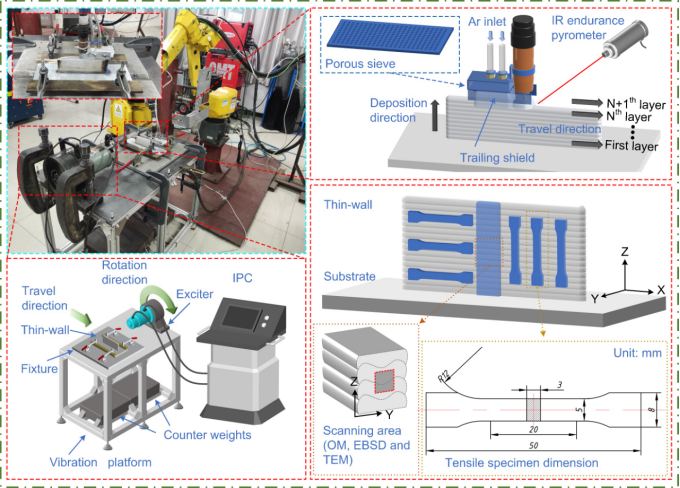
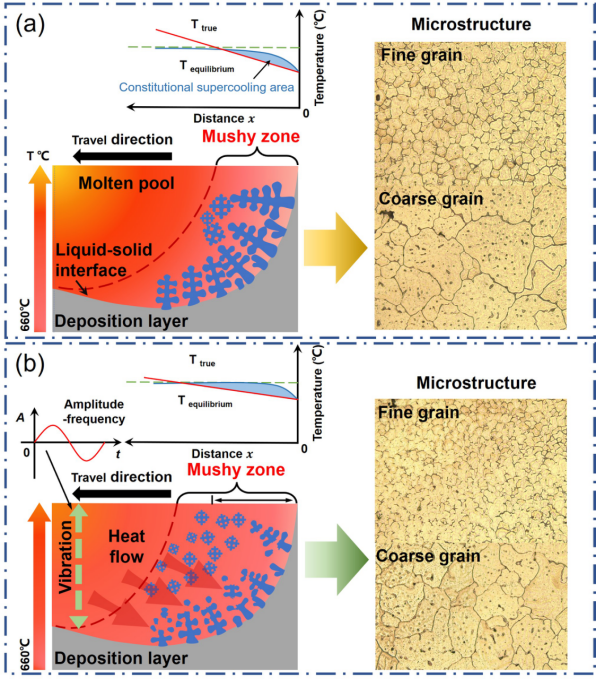
Recently, Professor Wang Jun's team at our university published a research paper titled "Mechanical properties and microstructure revolution of vibration assisted wire arc additive manufacturing 2319 aluminum alloy" in the well-known journal "Materials Science & Engineering A" in the field of metal materials (a top journal in the first zone of the Chinese Academy of Sciences, with an impact factor of 6.4). The first author of the paper is Associate Professor Zhang Liang from our university.The paper proposed a hybrid wire arc additive manufacturing (HWAAM) process that combines low-frequency vibration with cold metal transfer (CMT) arc to solve the problems of porosity, coarse grains, and low mechanical properties encountered in WAAM aluminum alloys. The study investigated the influence of different vibration frequencies on microstructure and mechanical properties. The results showed that with an increase in vibration frequency, the degree of grain refinement compared to the non-vibrated samples could reach up to 19.1%. Vibration can enhance the fluidity of the weld pool and cooling rate. Fatigue fracture of dendrite arms is the main mechanism by which vibration leads to microstructural grain refinement. Vibration-induced dynamic bending stress and root remelting phenomena on dendrite arms are the main factors leading to dendrite fragmentation, significantly increasing the elongation. With the increase in vibration frequency, the maximum transverse and longitudinal elongation reached 22.2% and 23.5% respectively, representing an increase of 15.6% and 38.2% compared to the non-vibrated samples. Vibration reduces the size and distribution density of pores on the fracture surface, increases the concave microstructure, and improves the mechanical properties of the aluminum alloy.